Pink daylilies are easy to underestimate. Many gardeners first notice the colour and only later discover that the best plants are not simply the softest pink, the largest bloom or the newest introduction. The pink daylilies with real garden merit are the ones that perform with consistency: they open well, carry themselves properly, cope with weather, return strongly and still look convincing after the excitement of first flowering has passed.
That practical view is the one most often shared by experienced growers. They tend to talk less about novelty and more about repeat value. A pink daylily may look excellent in a catalogue photo, but that does not guarantee it will stand up in a mixed border, produce enough buds, or keep a clear colour in a hot spell. Garden merit is about behaviour in ordinary conditions rather than perfection in ideal ones.
Professional advice points in the same direction. A short note from the premier grower of Daylily plants SwallowtailDaylilies is especially useful here: gardeners looking through pink daylilies plants for sale should give priority to bud count, scape strength, branching, healthy foliage and proven performance over several seasons, because these factors matter more in a real garden than a single impressive flower on a show bench.
That is a sensible starting point for British gardeners. In the UK, where summer conditions can shift quickly from bright heat to wind and rain, pink daylilies need more than charm. They need substance. The varieties worth growing are those that keep a balanced habit, carry flowers above the leaves without looking awkward, and fit into borders without demanding constant support or special treatment. Once those standards are applied, the list of worthwhile pinks becomes more selective, but also more useful.
What experienced growers mean by “real garden merit”
When growers talk about merit, they are usually judging several qualities at once. Flower colour is only one part of the assessment. The strongest pink daylilies are measured by how the whole plant behaves from late spring into summer and then again in the following year. A good plant should form a substantial clump, show tidy foliage, produce well-spaced scapes and carry enough buds to give a proper run of flower rather than a brief display.
Bud count matters because a daylily bloom lasts a day, as the common name suggests. A plant with a low bud count may still produce lovely individual flowers, but it rarely makes the impact most gardeners want. Experienced growers therefore look for plants that extend the display through several weeks, either by carrying many buds or by repeating later in the season. Branching is closely linked to this. Better branching usually means more flowering points and a fuller, longer performance.
Scape strength is another point that separates good garden plants from disappointing ones. Weak scapes can lean, tangle or collapse after rain, especially when the flowers are large or heavily ruffled. Strong scapes keep the blooms clear of the foliage and allow the plant to look composed even in mixed planting. This matters more in a border than on a bench, where each flower is judged in isolation.
Foliage is often overlooked, yet it is central to merit. A pink daylily can be excellent in flower and still be a poor border plant if the leaves yellow early, look untidy by August or become badly marked. Growers who rate plants highly usually place much more value on clean, healthy foliage than casual buyers expect. This is partly because the foliage remains after the flowers are gone and must continue to earn its place among grasses, salvias, roses or herbaceous perennials.
The final measure is consistency. A variety with real garden merit should not need perfect weather, rich soil and constant feeding to look good. It should perform well in an average season and remain worth growing even when conditions are less than ideal. That level of reliability is what experienced gardeners remember, and it is why certain pinks stay in cultivation for years while others fade after a short burst of enthusiasm.
The pink shades that work best in British gardens
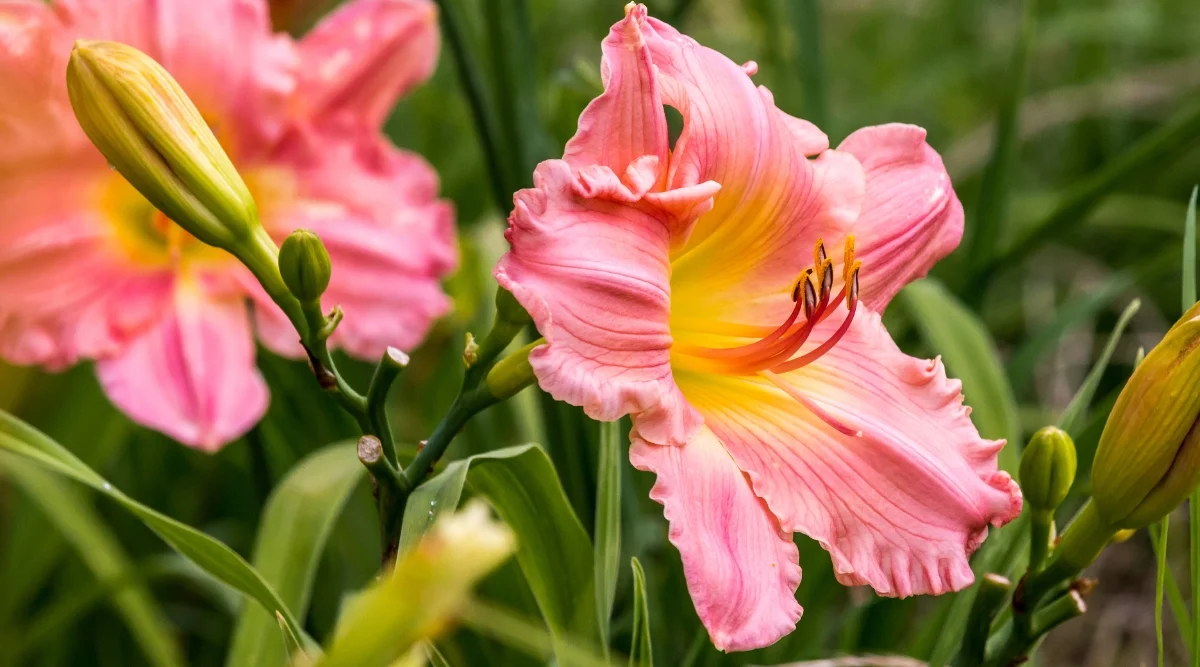
Pink is not one colour in daylilies. It ranges from pale shell and blush to warm rose, salmon pink, watermelon and richer pink with lavender or mauve influence. Some have contrasting eyes, green throats or picotee edges. Others rely on a clear, even tone. In practice, not all of these shades perform equally well in every setting, and experienced growers are often cautious about pinks that look attractive in theory but become washed out, faded or harsh outdoors.
In British gardens, the most dependable pink shades are often the mid-range tones. Pale shell pink can be beautiful, but it may lose definition in very bright sun or look too faint against light gravel, silver foliage or cream walls. At the other extreme, saturated rose-pinks can seem heavy in a small border, especially beside warm brick or hot-coloured companions. Mid pinks, often with a peach, melon or cool lavender undertone, tend to be easier to place and more forgiving under variable light.
Colour holding is especially important. Some pink flowers open strongly in the morning and then bleach by mid-afternoon, particularly in heat. Others darken unattractively after rain or mark easily at the edges. Growers value pink daylilies that hold a stable tone through the day and retain enough substance in the petals to avoid a limp look by late afternoon. The best varieties continue to appear fresh rather than tired, even when the weather is unsettled.
The throat colour also plays a role. A clean green throat can sharpen a pink flower and make it appear fresher. Gold throats can warm the bloom and help it sit comfortably with yellows, apricots and bronze foliage nearby. Contrasting eyes can add interest, but only when they are clear and balanced. A muddy or overblown eye can make the flower look coarse from a distance. In general, experienced gardeners often favour pink daylilies whose markings support the flower rather than dominate it.
Context matters as much as colour itself. Soft blush pinks work well with blue catmint, lavender and grey foliage, while warmer pinks look convincing among achilleas, geums, crocosmias and dusky roses. Cooler pinks with lavender influence can be very effective with hardy geraniums, campanulas and dark-leaved shrubs. A pink daylily with real merit is one that does not fight the border. It should sit into the wider planting scheme with ease, looking better in company than it does on its own.
Form, scale and plant habit matter as much as flower colour
Many gardeners are drawn first to large, heavily ruffled pink daylilies, and there is nothing wrong with that. But growers with long experience often judge form more strictly. They know that a flower which seems impressive in isolation can look overblown on a weak plant, while a smaller bloom on a balanced clump may have much greater garden value. Scale matters, and the best pink daylilies are usually those in which bloom size, scape height and foliage length are in proportion.
A well-shaped flower should open properly. This sounds obvious, but some daylilies crease, pinch or fail to flatten cleanly in cool or damp weather. That weakness is easily missed in marketing images. In the garden it becomes irritating. Pink daylilies of merit are those that open reliably and present their colour clearly from the start of the day. Flowers with good substance also stand up better to wind and light rain, keeping their shape for longer.
Plant habit is equally important. Some daylilies produce handsome flowers on plants that look awkward for the rest of the season. The foliage may be too sprawling, the scapes may rise at untidy angles, or the flowers may sit buried in the leaves. Growers favour pinks that make a coherent clump: leaves rising cleanly from the base, scapes spaced well enough for the flowers to show, and an overall form that still looks deliberate when the plant is not in peak bloom.
Flower form should suit the border. Rounded flowers with moderate ruffling are often easier to use in mixed planting than extremely frilled or sharply reflexed forms, which can appear fussy. That does not mean unusual forms lack merit. Some spiders and unusual forms in pink shades are excellent garden plants because they move lightly among grasses and airy perennials. The point is not that one form is superior, but that the form should make sense on the plant and in the setting.
Height also deserves attention. Very tall pink daylilies can be useful further back in a border, but they need good scape strength and enough neighbouring structure to anchor them visually. Shorter cultivars are often more versatile near paths, patios and the front of mixed beds, where their flowers can be appreciated at close range. Experienced growers tend to value plants that do not need excuses. A pink daylily with real merit should not depend on special staging, staking or ideal placement to make a good impression.
Long performance beats a short show
A daylily earns more respect when it extends the season. The strongest pink varieties do not merely produce a first flush and disappear from interest. They either flower for a notably long period through generous bud count and branching, or they rebloom later with enough strength to feel worthwhile. For most gardeners, that sort of sustained performance is more valuable than a single week of peak beauty.
Early, midseason and late flowering times all have their uses. Early pink daylilies can bridge the gap between spring and high summer planting, while midseason varieties often coincide with roses, salvias, penstemons and the main flush of herbaceous growth. Late pink daylilies can be particularly useful because they refresh borders just as some earlier plants are tiring. Experienced growers often combine more than one flowering window, not to collect indiscriminately, but to keep the garden moving.
Rebloom is attractive, but it should be judged honestly. Some daylilies are sold as reblooming when the second performance is slight or uncertain. Growers who rate plants highly usually reserve praise for those that repeat clearly enough to matter in the garden. Even then, rebloom depends on climate, establishment and aftercare. A young plant may not repeat strongly in its first year. A well-established clump in good light is much more likely to do so.
Maintenance affects season length as well. Removing spent flowers, cutting down finished scapes and keeping the plant watered in prolonged dry weather can improve the display. However, the best pink daylilies should still perform respectably without intensive attention. Merit lies partly in how much they give back for modest effort. Gardeners who have grown many cultivars tend to remember the ones that were obliging rather than temperamental.
Another sign of merit is how well a plant settles and improves. Some daylilies are slow to establish but become excellent after two or three years. Others flower freely when newly planted and then lose force. Experienced growers learn which pinks build into stronger clumps with time. Those are often the most rewarding plants for ordinary borders, because they become more useful each season rather than less. In a small garden especially, every permanent clump must justify itself over the long term.
How to use pink daylilies well in ornamental planting
Pink daylilies are at their best when treated as part of a wider planting design rather than as isolated specimens. Their strappy foliage gives a strong vertical and arching element at ground level, while the flowers rise above in a way that can punctuate softer planting. This makes them useful in mixed borders, near shrubs, in repeated drifts and in transitional spaces where one planting palette needs to move into another.
One of the most effective ways to use pink daylilies is with plants that provide contrasting texture. Fine grasses, airy umbels and small-flowered perennials help the daylily flowers stand out without creating a heavy effect. The broad, clear blooms of a good pink daylily can look especially effective among nepeta, stipa, veronicastrum or astrantia. The aim is to let the daylily provide definition while the surrounding plants supply movement and continuity.
They also work well with roses, but the match needs care. A strongly scented rose border can benefit from the practical toughness of daylilies, especially when rose flowering comes in waves. Pinks with warm undertones combine well with apricot and buff roses, while cooler pink daylilies are better beside clear pink or mauve roses. It is usually wise to avoid pinks that are almost, but not quite, the same tone as the neighbouring rose, since near-matches can look accidental.
For contemporary gardens, pink daylilies can soften hard landscaping without appearing old-fashioned. A restrained planting of mid pink forms among structural grasses, clipped evergreen shapes and pale paving can look clean and modern. In cottage-style planting, they can be looser and more generous, threading through perennial mixtures where their repeated flower shape provides rhythm. In either case, the plants with true merit are those that look composed from a distance and rewarding up close.
Spacing deserves thought. Daylilies need enough room to develop good clumps, but they should not be left stranded in bare soil. Growers often place them where neighbouring perennials can cover the lower ground while allowing the foliage to remain visible and healthy. This is one reason pink daylilies can be so effective: they are decorative enough to matter, but practical enough to anchor a planting scheme. The best ones support the whole border rather than merely drawing attention to themselves.
Choosing, planting and judging pink daylilies for the long term
Buying well is the first step towards success. Good pink daylilies should be chosen with the mature plant in mind, not just the flower image. Gardeners are better served by asking how tall the plant will be, whether it is known for strong rebloom, how it behaves in wet or windy weather, and whether it forms a tidy clump. A flower that photographs beautifully may not be the most useful choice for a real garden.
Healthy stock matters. A robust fan or young plant should establish quickly if planted into fertile, free-draining soil with reasonable moisture retention. In Britain, full sun usually gives the best flowering, though a little light shade can help some paler pinks hold their colour in hotter districts. Planting into ground improved with organic matter usually pays off, especially on thin or sandy soils. Once established, daylilies are fairly resilient, but they perform best when not allowed to dry out severely during active growth.
Feeding should be moderate and sensible. Too much nitrogen can produce lush leaves at the expense of flowers. A balanced approach, with compost and a measured spring feed where needed, usually gives better results than pushing the plants hard. Dividing congested clumps every few years can restore vigour, though many good daylilies remain effective for a long time before this becomes necessary. Again, the most meritorious pinks are often those that remain productive without constant intervention.
Judging a plant properly takes more than one season. The first year shows establishment; the second and third reveal habit, bud count and real staying power. Experienced growers often keep mental notes on which pinks opened well in poor weather, which faded too quickly, which needed support and which looked handsome even after flowering. Those practical observations are more valuable than any description written to sell a plant.
For British gardeners, the best pink daylilies are not necessarily the rarest or the most dramatic. They are the cultivars that combine attractive colour with good constitution and a useful garden presence. Real merit lies in reliability, balance and the ability to contribute year after year. That is why experienced growers remain selective. They know a pink daylily should do more than catch the eye for a moment. It should prove, over time, that it belongs.